DevOpsEnvy: An Education Support System for DevOps
Nov 7, 2017· ·
1 min read
·
1 min read
Shenghui (Samuel) Gu
Abstract
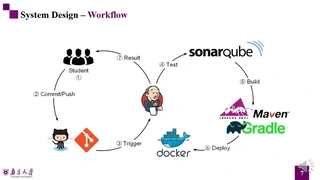
As an emerging approach to support fast delivery of software features with reliable quality, DevOps attracts more and more practitioners and shows the potential to become one of the mainstream approach for software development and operation. Many universities begin to offer DevOps related courses to the students majored in software engineering and computer science. However, as a critical part of a DevOps course, the project practicing using DevOps might cast big challenges for teachers, compared to traditional project practicing. For example, the more frequent than ever delivery in DevOps practicing will inevitably increase the workload vastly for teachers to conduct effective evaluation. In this paper, we introduce a web based system (DevOpsEnvy) to support the management and monitoring of student teams practicing DevOps. By integrating several popular open source tools, this system provides students with features such as group management, project status monitoring and student performance data analysis, etc. Meanwhile, DevOpsEnvy system also provides teachers with sufficient evidence to perform evaluation. Our preliminary trial in Nanjing University revealed several advantages of DevOpsEnvy system.
Date
Nov 7, 2017 12:00 AM — Nov 9, 2017 12:00 AM
Event
Location
Virtual
Savannah, Georgia
This talk presents DevOpsEnvy, a web-based system that helps manage and monitor student DevOps projects, easing evaluation for teachers and supporting team collaboration.

Authors
Shenghui (Samuel) Gu
(he/him)
Postdoctoral Researcher
Postdoctoral Researcher at the University of Ottawa specializing in Trustworthy AI and Software Engineering, holding a Ph.D. from Nanjing University.
Research lies at the intersection of AI Safety and System Reliability, with deep expertise spanning LLM-driven testing, search-based software engineering for autonomous systems, and AIOps for distributed architectures.
Dedicated to developing rigorous, interpretable, and scalable methodologies that leverage generative AI to solve complex validation challenges in safety-critical and large-scale industrial systems.